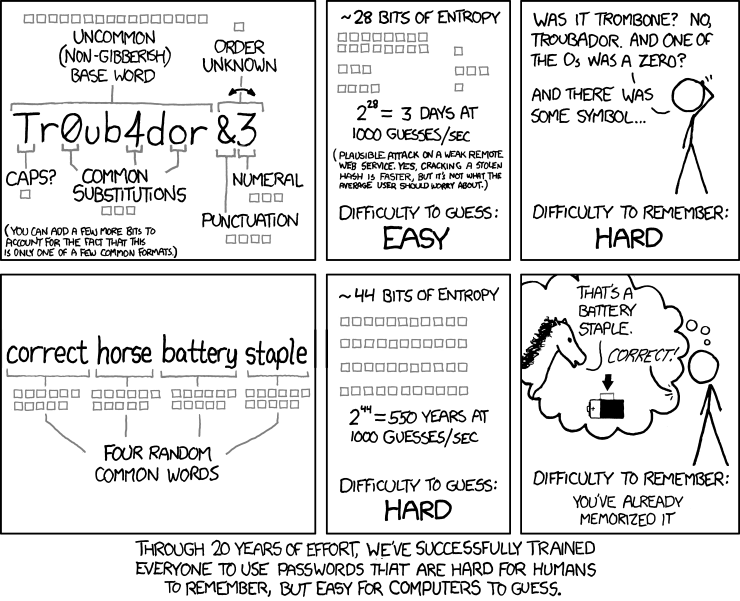
A great comic strip explaining how easy it is for you to get hacked and how to make a better password. Be sure to also activate the 2 step verification from my previous post.
xkcd: Password Strength
Showing posts with label iPhone. Show all posts
Tuesday, October 8, 2013
Sunday, September 22, 2013
Your personal security online...
Everyone uses locks on their doors at home and some even have a security system to protect their personal belongings. Some get a car alarm and even one with a GPS to prevent your car from being stolen. A password on your phone, but what about your email? No one seems to secure email and it's the most important thing online now.
Why is email important? Think about it. Where are all your forgotten passwords resets sent? Especially for your banking and credit cards? Email. All I need to do is enter your password and is it even a secure one? Is it your kids name? Your wife's? Does it contain letters or numbers? Or even capital and lower case letters? Chances are it's a simple password. Is your password on this list?
25 most-used passwords revealed
Here are the steps to make it more secure and some recommendations:
1. Make a better password. Check this link out: http://xkcd.com/936/
2. Use Two-step verification. It's a second code that is sent to you or generated by an app, that needs to be entered. Think of it as your work VPN token. I have more information below.
Here are some links to popular email services with their "How-to". If you don't use any of these, I would seriously consider switching.
Hotmail or Oulook.com: http://windows.microsoft.com/en-us/windows/two-step-verification-faq
Yahoo: http://help.yahoo.com/kb/index?page=content&y=PROD_ACCT&locale=en_US&id=SLN5013
Gmail: https://support.google.com/accounts/answer/180744?hl=en
Apple: http://support.apple.com/kb/HT5570
Facebook: https://www.facebook.com/note.php?note_id=10150172618258920
Enjoy your new piece of mind!
Why is email important? Think about it. Where are all your forgotten passwords resets sent? Especially for your banking and credit cards? Email. All I need to do is enter your password and is it even a secure one? Is it your kids name? Your wife's? Does it contain letters or numbers? Or even capital and lower case letters? Chances are it's a simple password. Is your password on this list?
25 most-used passwords revealed
Here are the steps to make it more secure and some recommendations:
1. Make a better password. Check this link out: http://xkcd.com/936/
2. Use Two-step verification. It's a second code that is sent to you or generated by an app, that needs to be entered. Think of it as your work VPN token. I have more information below.
Here are some links to popular email services with their "How-to". If you don't use any of these, I would seriously consider switching.
Hotmail or Oulook.com: http://windows.microsoft.com/en-us/windows/two-step-verification-faq
Yahoo: http://help.yahoo.com/kb/index?page=content&y=PROD_ACCT&locale=en_US&id=SLN5013
Gmail: https://support.google.com/accounts/answer/180744?hl=en
Apple: http://support.apple.com/kb/HT5570
Facebook: https://www.facebook.com/note.php?note_id=10150172618258920
Enjoy your new piece of mind!
Tuesday, June 26, 2012
The importance of software updates and upgrades...
With computers and technology advancing at an incredible rate, it is extremely important to do updates on existing devices and upgrade them when manufacturers end support on them. On average, technology has become obsolete in as little as 3 years. Support for those products also ends, which includes things like security updates and bug fixes. The most important being security fixes because this leaves you vulnerable.
One such example is the iPhone which is currently running iOS 5 with 6 due out later this year. As of 6/26/12, there are currently 141 vulnerabilities for that operating system. You can check the national database here:
http://web.nvd.nist.gov/view/vuln/search-results?query=apple+ios&search_type=all&cves=on
The other important reason to do the updates, is highlighted in my post here: http://www.atchan.com/2010/12/iphone-upgrade-warning.html
When you upgrade and migrate to your new device, it is best to keep up with incremental updates. As shown in my previous post. If you upgrade from iOS 1.1 to 3.1, there are A LOT of changes in how the data is handled. Things are improved, changed and fixed in each revision. If your data didn't do the natural progression of versions 1 to 2 to 3, you will lose that data. Software is designed to follow an order of progression, if you deviate, it will cause problems for you because the only way for them to keep track is through their revisions. Anything else creates too many variables that no one can track. Of course, you should always back up your data, but that is a totally separate post.
This also leads to another point. Large corporations, in an "attempt" to save money by pushing off "costly" upgrades and updates, actually pay much more, in most cases more than double, in the long tern when you are forced to upgrade when it comes to end of life support. Examples include additional hours required in attempting to keep the old data, problems that arise when attempting to connect older systems to newer systems, additional resources (hardware, 3rd party software, consultants) to bridge the time needed while the integration is tested, employee training, and down time related to problems in the upgrade. All these are additional costs that aren't calculated and end up costing so much more.
Software companies design the upgrade process into the newer products from the previous revision, not from older versions. For example, they will provide support for your migration from version 4 to 5, but as for version 3 to 5 you are on your own or will need to purchase 3rd party software specifically written to migrate that data and it is not always perfect because their software is based on a properly configured system. Which is NEVER the case because something is configured either differently or wrong.
One such example is the iPhone which is currently running iOS 5 with 6 due out later this year. As of 6/26/12, there are currently 141 vulnerabilities for that operating system. You can check the national database here:
http://web.nvd.nist.gov/view/vuln/search-results?query=apple+ios&search_type=all&cves=on
The other important reason to do the updates, is highlighted in my post here: http://www.atchan.com/2010/12/iphone-upgrade-warning.html
When you upgrade and migrate to your new device, it is best to keep up with incremental updates. As shown in my previous post. If you upgrade from iOS 1.1 to 3.1, there are A LOT of changes in how the data is handled. Things are improved, changed and fixed in each revision. If your data didn't do the natural progression of versions 1 to 2 to 3, you will lose that data. Software is designed to follow an order of progression, if you deviate, it will cause problems for you because the only way for them to keep track is through their revisions. Anything else creates too many variables that no one can track. Of course, you should always back up your data, but that is a totally separate post.
This also leads to another point. Large corporations, in an "attempt" to save money by pushing off "costly" upgrades and updates, actually pay much more, in most cases more than double, in the long tern when you are forced to upgrade when it comes to end of life support. Examples include additional hours required in attempting to keep the old data, problems that arise when attempting to connect older systems to newer systems, additional resources (hardware, 3rd party software, consultants) to bridge the time needed while the integration is tested, employee training, and down time related to problems in the upgrade. All these are additional costs that aren't calculated and end up costing so much more.
Software companies design the upgrade process into the newer products from the previous revision, not from older versions. For example, they will provide support for your migration from version 4 to 5, but as for version 3 to 5 you are on your own or will need to purchase 3rd party software specifically written to migrate that data and it is not always perfect because their software is based on a properly configured system. Which is NEVER the case because something is configured either differently or wrong.
Monday, December 27, 2010
iPhone upgrade warning....
Happy Holiday's everyone!
So I spent my holiday in a frantic trying to recover the data from a failed update. Apparently you can't migrate your data from iPhone OS 1.1.1 to 3.1.3 . iTunes doesn't tell you this and all the internet searches say "It's easy." NO it's not. Not sure if it's Apple propaganda or not. Good luck getting support for an out of warranty Apple device.
The firmware update happend flawlessly. The phone came back and booted into the home screen. Then it said to restore the data. After that the phone stayed on the Apple logo and the status bar never moves.
An update without the users data is useless...
BUT! I have a fix and managed to learn a few things...
1. BACK UP! Always back up before you perform any upgrade or update!
2. Apple sucks for backwards compatibility. They REALLY aren't backward compatible friendly. If the device is "Out of scope" it's just not supported. Like 64-bit on older iMacs that have a 64-bit processor, but due to a bios lock you can't run Snow Leopard in 64bit mode. WHY?? Oh, that's right. I have to buy a new iMac because the one that's only 3 years old isn't supported. End of life...
3. It's NOT easy locating Apple fixes in online searches. I pull up A LOT of pages telling you how to do it. Not many, when it fails and it does fail.
4. Apple.com support KB's sucks even more. Their searches are almost useless.
So, how did I recover?
1. Look for where your back up is stored. The file names won't look like anything you know. I had to go by the date and time it was modified. Copy the entire folder to a USB drive or other locations. DO NOT use the original files. You may need to go back to them.
On a Mac: ~/Library/Application Support/MobileSync/Backup/
On Windows XP: \Documents and Settings\(username)\Application Data\Apple Computer\MobileSync\Backup\
On Windows Vista and Windows 7: \Users\(username)\AppData\Roaming\Apple Computer\MobileSync\Backup\
2. I located an app. http://www.iphonebackupextractor.com/ It saved my life for $25.
3. I extracted the data from the files and there is no easy way to get the files back on the phone. EXCEPT... to export the Contacts as CSV files and Calendar as iCal file.
Both Hotmail and Gmail support Active Sync. I suggest importing them into those mail clients and use Active Sync to get your mail. This will also provide an online back up for all your contacts so in the future something like this won't be a disaster.
I hope this helps.
So I spent my holiday in a frantic trying to recover the data from a failed update. Apparently you can't migrate your data from iPhone OS 1.1.1 to 3.1.3 . iTunes doesn't tell you this and all the internet searches say "It's easy." NO it's not. Not sure if it's Apple propaganda or not. Good luck getting support for an out of warranty Apple device.
The firmware update happend flawlessly. The phone came back and booted into the home screen. Then it said to restore the data. After that the phone stayed on the Apple logo and the status bar never moves.
An update without the users data is useless...
BUT! I have a fix and managed to learn a few things...
1. BACK UP! Always back up before you perform any upgrade or update!
2. Apple sucks for backwards compatibility. They REALLY aren't backward compatible friendly. If the device is "Out of scope" it's just not supported. Like 64-bit on older iMacs that have a 64-bit processor, but due to a bios lock you can't run Snow Leopard in 64bit mode. WHY?? Oh, that's right. I have to buy a new iMac because the one that's only 3 years old isn't supported. End of life...
3. It's NOT easy locating Apple fixes in online searches. I pull up A LOT of pages telling you how to do it. Not many, when it fails and it does fail.
4. Apple.com support KB's sucks even more. Their searches are almost useless.
So, how did I recover?
1. Look for where your back up is stored. The file names won't look like anything you know. I had to go by the date and time it was modified. Copy the entire folder to a USB drive or other locations. DO NOT use the original files. You may need to go back to them.
On a Mac: ~/Library/Application Support/MobileSync/Backup/
On Windows XP: \Documents and Settings\(username)\Application Data\Apple Computer\MobileSync\Backup\
On Windows Vista and Windows 7: \Users\(username)\AppData\Roaming\Apple Computer\MobileSync\Backup\
2. I located an app. http://www.iphonebackupextractor.com/ It saved my life for $25.
3. I extracted the data from the files and there is no easy way to get the files back on the phone. EXCEPT... to export the Contacts as CSV files and Calendar as iCal file.
Both Hotmail and Gmail support Active Sync. I suggest importing them into those mail clients and use Active Sync to get your mail. This will also provide an online back up for all your contacts so in the future something like this won't be a disaster.
I hope this helps.
Subscribe to:
Posts (Atom)

